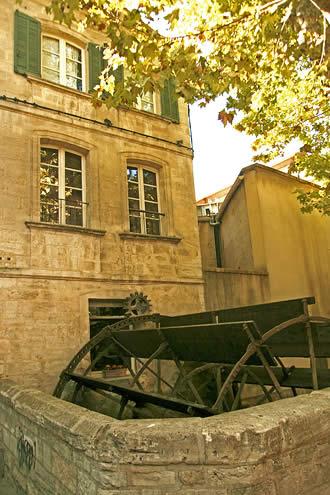
La rue des Teinturiers est une rue pittoresque pavée avec des galets de la Durance. Elle part des remparts et suit la Sorgue jusqu'au croisement de la rue des Lices.
Elle est appréciée l'été pour la fraîcheur qui émane du canal et par l'ombrage qu'offrent ses majestueux platanes. Pendant le Festival, de nombreux cafés et restaurants vous proposent d'attendre agréablement le début des piècUes de théâtre. Du matin jusqu'au tard le soir, vous pourrez profiter de cette ambiance exceptionnelle, que vous soyez spectateur ou simple badaud. Découvrir l'histoire de cette rue pittoresque et en même temps, celle de ses habitants, c'est découvrir l'histoire d'Avignon toute entière...
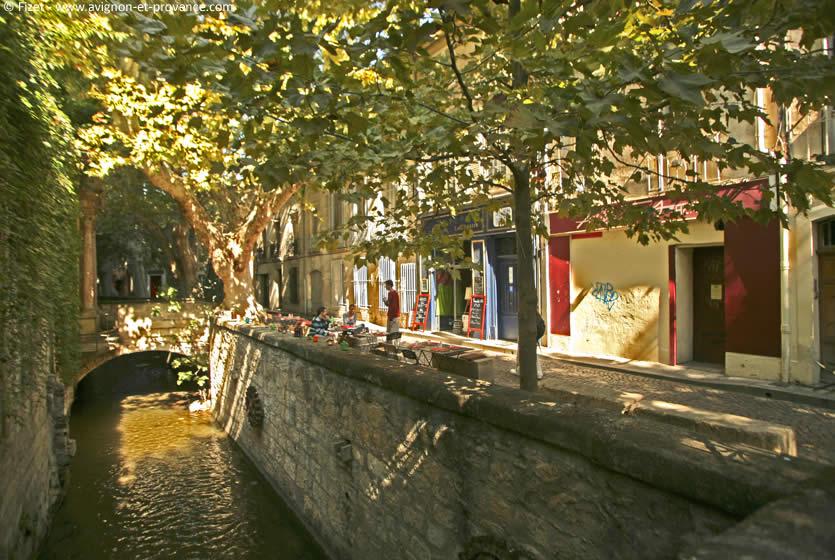
La rue des Teinturiers à Avignon
La rue des Teinturiers, surnommée la rue des Aubes, tire son nom de l'intense activité industrielle liée aux textiles qui fleurissait entre les XIVè et XIXè siècles.
La rue suit la Sorguette, alimentée par les eaux provenant de Fontaine de Vaucluse. Au Xè siècle cette eau remplissait les fossés au pied des remparts avant de se transformer en force motrice pour des moulins nécessaires à l'industrie de la soie à partir de 1440. Le XVIè siècle a vu naître les fabriques d'indiennes donnant du travail aux teinturiers et garanciers, mais aussi aux tanneurs et corroyeurs.
Quatre roues subsistent et témoignent encore de ce passé.
En effet, la rue et le quartier des Teinturiers incarnent à eux seuls presque toute l'histoire de la vie populaire d'Avignon.
Vous le comprendrez aisément en vous promenant le long de cette rue ombragée et, pendant le Festival, très animée.
Au début, à l'angle de la rue des Lices, on voit une des chapelles et le clocher qui subsistent de l'église qui était l’une des plus vastes d’Avignon, l'ancien couvent des Cordeliers, un ordre religieux mendiant installé à Avignon en 1226. Le couvent comptait de nombreuses chapelles mortuaires. À l'époque, les cimetières étaient carrément les lieux de rendez-vous des marchands et commerçants, des joueurs de cartes, des prostituées et on se plaignait même que les cochons déterraient les cadavres fraîchement inhumés.
On comprend mieux donc pourquoi certains notables choisirent ce lieu pour abriter leurs tombeaux, dont le Cardinal Pierre de Foix, premier légat d'Avignon, la famille Baroncelli et Laure de Noves, célèbre muse du non moins célèbre Petrarque.
Une petite parenthèse : un jeune lycéen débrouillard du lycée situé à coté milite depuis 2014 pour que ce couvent, lieu de l'assassinat du révolutionnaire Nicolas Lescuyer qui a provoqué le massacre de la Glacière en 1791, soit classé monument historique.
Plus loin, sous l'ombre des grands platanes se dresse la Chapelle des Pénitents Gris, ouverte à la visite. Le roi Louis VIII venu à Avignon en 1226 fonda cette confrérie qui a pour vocation l’adoration du Saint-Sacrement. La plus ancienne confrérie d’Avignon, elle est toujours en activité et chaque 30 novembre les membres célèbrent un miracle : ce jour en 1433, malgré une crue du Rhône et l'inondation de la Sorgue, les eaux dans la nef s'écartèrent laissant un passage pour que les pénitents puissent évacuer le Saint Sacrement.
Continuons notre chemin. La Salle Bénoit XII est gérée par l'Institut supérieur des techniques du spectacle. Et parmi les bistrots et restaurants bien fréquentés des Avignonnais, la maison du célèbre naturaliste Jean-Henri Fabre se trouve au numéro 14, derrière une impressionnante roue à aubes.
Puis, crénelée, flanquée de deux échauguettes et de gargouilles d'animaux fabuleux, l'énigmatique Maison du IV de Chiffre à l'angle de la rue Guilaume Puy, est l’une des dernières demeures gothiques d’Avignon, construite en 1493. Elle tire son nom d’un monogramme gravé sur sa façade dont le mystère de la signification n'a toujours pas été résolu. Mais le quatre de chiffre, utilisé très couramment au XVe siècle, est un ensemble de symboles qui a fait partie des anciennes marques de métiers corporatifs. Aujourd'hui, un peu dans le même esprit, le bâtiment abrite la Maison des Associations et se transforme en salle de spectacle pendant le Festival d'Avignon OFF.
En face, à l'autre angle de la rue, se trouve la maison de Jules-François Pernod, fondateur à Avignon de la marque d'apéritif qui porte son nom.
Et juste devant, encore une grande roues à aube parmi des trois roues hydrauliques qui se trouvent au bout de la rue.
A l'époque, tout au long de la rue, les machines étaient installées dans les maisons en face des roues (au nombre de 23 en 1817) et mues par un axe qui traversait la rue à une faible profondeur. La démolition d'un ancien local a mis à jour un des arbres de transmission avec son mécanisme. Et si, au niveau de la dernière roue, vous vous penchez au dessus de la Sorgue vous verrez le support et cylindre.
Mais toute cette activité a finalement cédé à une fleurissante industrie touristique. Allons, prenons un verre en attendant le début d'un spectacle.
Où dormir ?
Art de vivre
Recettes provençales, marchés de provence, traditions de Noel, savoir-faire...