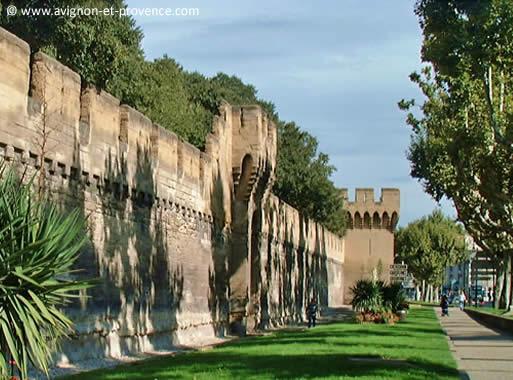
Le centre ville d'Avignon est entièrement ceint de 4.3 km de remparts.
Même si l'absence des fossés, des tours à pont-levis, des portes de bois bardées de fer altère sa physionomie initiale, ils offrent un témoignage saisissant des entreprises de fortifications du XIVe siècle en France.
Depuis l'époque romaine, au cours des années et des aléas historiques, le périmètre de la ville s'est progressivement étendu et ses protections furent successivement modifiées, sauf pendant les périodes de guerre ou d'épidémies où la population se repliait autour du noyau originel de la ville, le Rocher des Doms. Avignon eut donc plusieurs remparts différents au cours de son histoire. Le Rocher à proprement parler ne servait probablement que de refuge et de poste de surveillance sur toute la région environnante.
Les remparts d'Avignon
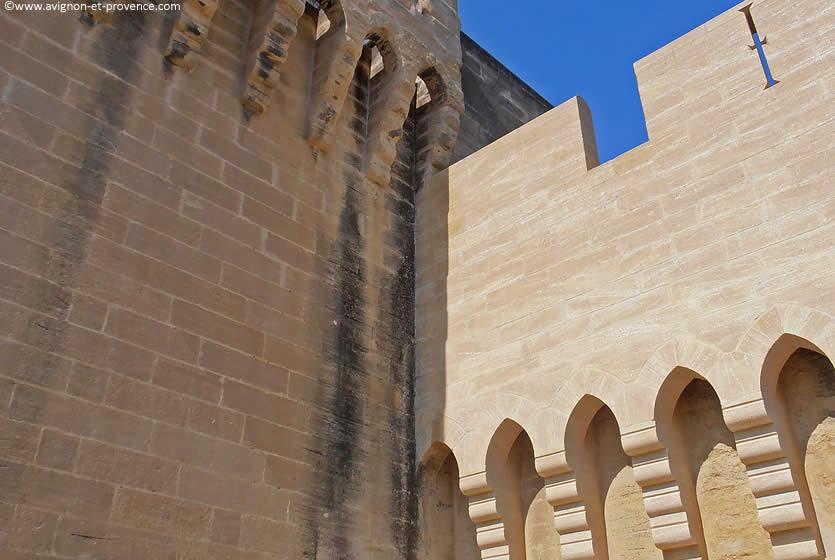
Détail de la restauration des remparts d'Avignon
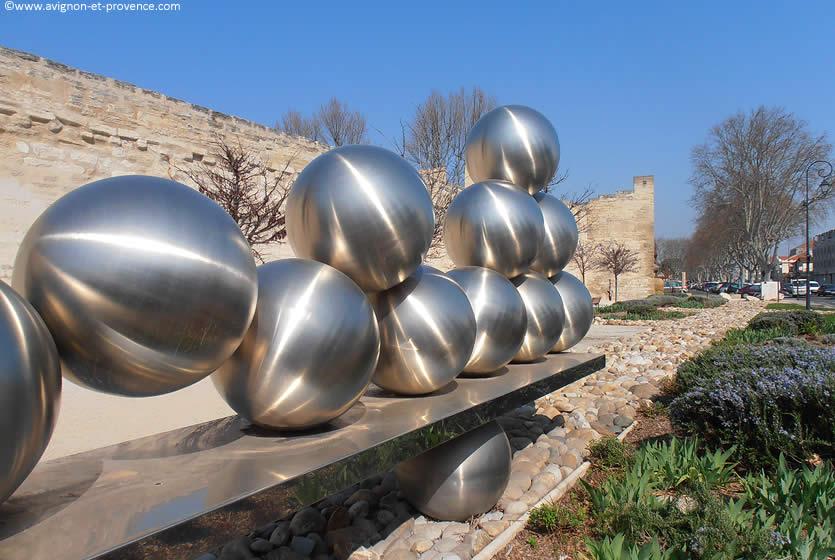
Balance de la Justice - Remparts d'Avignon
Une enceinte fut édifiée au Ier siècle par les Romains, malheureusement aucun document ne permet aujourd'hui d'affirmer son tracé exact. L'hypothèse formulée par M. Sylvain Gagnière, et reprise par la plupart des historiens locaux en délimite le périmètre ainsi :
Le tracé de cette fortification de forme pratiquement rectangulaire correspondant tout à fait au type habituel des enceintes romaines.
Au XIIe siècle, une double enceinte avec fossés qui est édifiée pour protéger la ville, le plus petit périmètre correspondant à peu près avec celui du rempart romain décrit précédemment. Les avignonais, sûrs de leur puissance et de leur invulnérabilité crurent pouvoir résister aux armées du roi de France en route pour une croisade contre les l'hérésie albigeoise.
En 1226, aprés un siège de trois mois, la ville capitule devant le roi de France Louis VIII, qui fit abattre une grande partie des murailles et combler les fossés, avec interdiction formelle de relever les murs avant cinq ans.
De 1234 à 1237, les Avignonnais réédifièrent un nouveau rempart, trente à quarante mètres à l'extérieur des ruines du précédent ; délimité dès lors d'est en ouest par les rues : Trois Colombes, Campane, Philonarde, Lices, Henri Fabre, Joseph Vemet et Grande Fusterie.
A l'angle de la rue Saint-Charles est encore visible un fragment de cette muraille.
Il fallut en réalité quelques années supplémentaires pour achever totalement l'ouvrage. En 1248, il était définitivement terminé et la population, bien à l'abri derrière ses murs relevés, put observer du haut de ses remparts tout neufs les croisés du roi Saint Louis, en route pour la Terre Sainte via Marseille et Aigues Mortes.
Avec l'arrivée des papes, l'agglomération s'est rapidement agrandie et de nouveaux bourgs se formèrent à l'extérieur des murs, le pape Innocent VI commence en 1355 la construction d'une nouvelle muraille protectrice qui englobera les nouveaux édifices. C'est le rempart actuel.
Il était d'autant plus jugé nécessaire par le Pape, qu'en cette époque de la guerre de cent ans, la vallée du Rhône était écumée par des bandes de routiers pour la plupart composées de mercenaires renvoyés par les Anglais après la trève de Bordeaux du 23 mars 1357.
Parmi les grandes compagnies restées tristement célèbres, on retiendra "La Compagnie Blanche", "Les Tards Venus" avec à leur tête un ex-chevalier gascon, Seguin de Badefols, qui prendront Pont-Saint-Esprit dans la nuit du 28 au 29 décembre 1360, "l'armée d'Arnaud de Cervolle" qui avait servi le duc d'Alençon à la bataille de Poitiers, prince pillard, archiprêtre de Velines en Périgord, qui obligea le Pape à lui verser la somme de mille florins le 29 septembre 1358, contre son départ et la levée du siège qu'il avait mis à Avignon. Une fois satisfait, il empoche la rancon et licencie ses troupes sur place. Celles-ci privées de chef furent encore plus dangereuses.
En 1359, les remparts ne sont pas achevés, aussi par mesure de sécurité supplémentaire Innocent VI fait réparer les anciennes portes, afin de former une deuxième ligne de défense, mais en ville, sévissent les Alperugues ou Dampierres qui sèment la terreur.
Au mois de juillet 1359 cette société de scélérats commet d'effroyables désordres, allant jusqu'à rendre les rues impraticables.
Le Pape réagit aussitôt et, inflexible, ordonne une prompte justice. Noyades et pendaisons après de sommaires jugements eurent tôt fait de rétablir l'ordre dans la cité.
Le 8 mars 1360, les hostilités cessent entre la France et l'Angleterre après la signature du traité de Bretigny. Une nouvelle fois la région est envahie par les mercenaires débauchés, qui, livrés à eux-mêmes, reforment des bandes composées, cette fois, en majorité d'Anglais brigands et pillards.
Le Pape imagine alors une sorte de croisade pour libérer le pays.
Il place à sa tête, comme capitaine général du Comtat, le grand prieur d'Emposte en Aragon, Juan Fernandez de Heredia, chevalier de Saint-Jean de Jérusalem. Ce dernier obtient aprés le siège de Pont-Saint-Esprit que ces bandes iront se battre en Italie, sous les ordres du marquis de Montferrat, moyennant la somme de quatorze mille cinq cents florins d'or, pour laquelle le Pape, les Avignonnais et les Comtadins durent se cotiser.
4 ans plus tard, le 5 novembre 1365, c'est Bertrand Du Guesclin, à la tête des "Pélerins de Dieu" constitués de trente mille croisés, qui est en vue des remparts. Il est chargé par le roi de France Charles V le Sage de purger la vallée du Rhône des compagnies encore existantes, en les emmenant en Espagne pour les remettre à Enrique de Trestamare alors en guerre contre Pedro de Castillo allié du roi d'Angleterre Edouard III. La menace de pillage représentée par cette armée fut, là aussi, évitée grâce à l'absolution de leurs péchés par le Pape et surtout par la remise d'une rançon importante (de 30.000 à 200.000 florins d'or selon les sources).
Les terroristes et autres preneurs d'otages qui sévissent de nos jours n'ont hélas rien inventé...
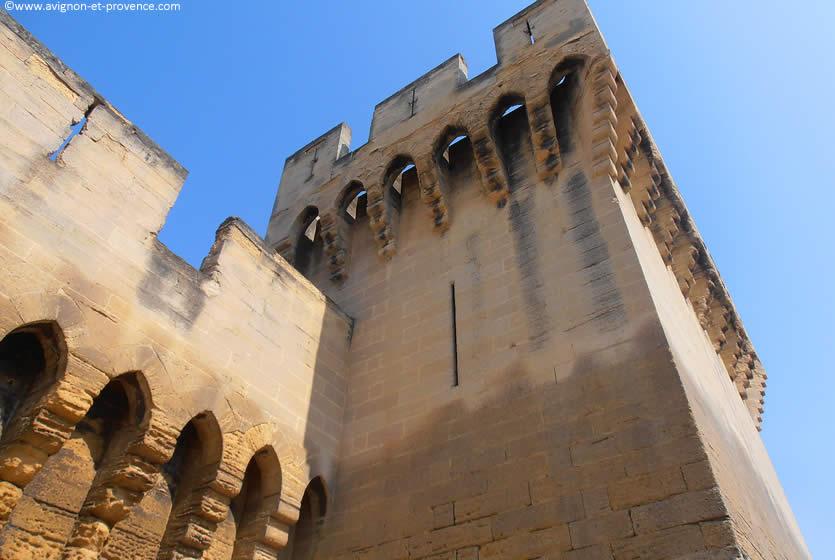
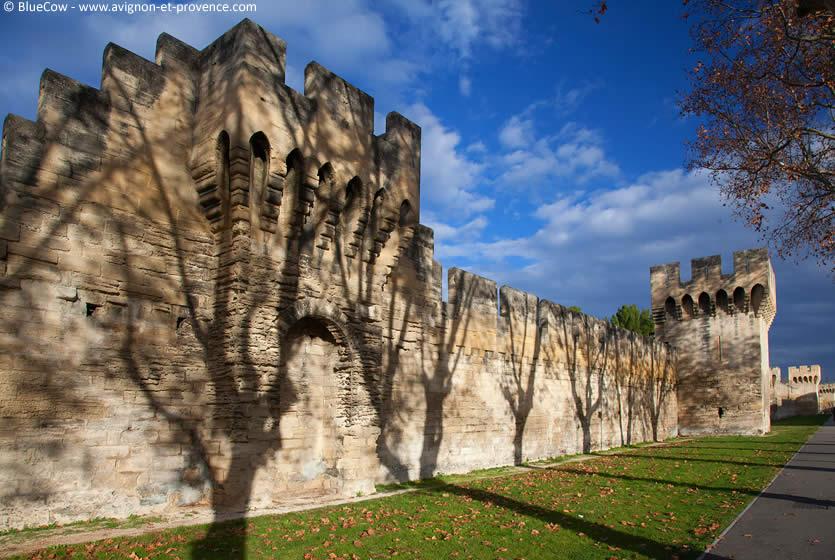
Remparts d'Avignon avec créneaux et machicoulis
La totalité de son périmètre est de 4.330 mètres, délimitant une surface de 151 hectares 71 ares, trois fois et demi supérieure à la superficie que limitait l'ancien rempart.
Un large fossé profond de quatre mètres, alimenté par les eaux de la Sorgue et de la Durançole en défendait l'accés. Les sept portes de la ville, munies de ventaux de bois bardés de fer, que l'on fermait le soir, étaient commandées par des tours précédées de pont-levis, auxquels s'ajoutaient des herses par mesure de protection supplémentaire.
Le rempart était haut d'environ huit mètres, et garni de créneaux et de machicoulis. Il était renforcé par trente cinq grandes tours et cinquante tours intermédiaires plus petites, presque toutes carrées ou rectangulaires, sauf trois semi-circulaires (Au XVè siècle, on y rajouta une tour polygonale).
Du fait de l'existence de ces remparts différents au XIIIè et XIVè siècle, il est logique de rencontrer au cours de l'histoire de la ville, deux portes Limbert, ou plus exactement deux portails Imbert. L'un à la rencontre des rues Philonarde, Bonneterie, Lices et Teinturiers que l'on nomma "Portail Imbert Vieux" ou "Antique" ou "Portail Peint". Le second appelé "Portail Imbert Neuf" étant l'actuelle Porte Limbert.
Copyright Textes de Marc Maynègre
Où dormir ?
200 € par nuit*
Location de vacances - Avignon et ses alentours
Art de vivre
Recettes provençales, marchés de provence, traditions de Noel, savoir-faire...