If you are coming to visit Provence, don't stop in Avignon!
Once here, like a siren, the city will entrance you and you won't want to leave!
And just to see the sights, you can spend days wandering the neighbourhoods within the city walls and never get bored.
Avignon is full of history and full of life.
Capital of the Vaucluse and the Côtes du Rhône, seat of the popes and city of art and culture, theatre, cinema, museums, big stores and little shops, Avignon is a small city that has everything a big one has, and then some...
From medieval streets and houses to private mansions from the Renaissance, passing through all its old and enticing squares, some no bigger than a tiny lane... And the diverse dining opportunities, ranging from family-run restaurants, good and inexpensive to some of the greatest Michelin-starred chefs.
Avignon invites you for a stay beyond all imagination.The historic city centre, the Popes' Palace, all the episcopal buildings and the Saint Bénézet Bridge are listed as world heritage sites by UNESCO.
The historic centre radiates from the Place de l'Horloge.
Here, you find the City Hall built between 1845 and 1851 over a former cardinal's palace of which it has kept the old fortified tower, transformed into a belfry in the 15th century with clock and Jacquemart. Next to it, the municipal theatre, also from the 19th century, houses the Avignon opera and, all the way at the top, the delightful Belle Époque style carrousel still turns.
Originally the forum of Avenio, the city's name under the Romans in the 1st century BC, the Place de l'Horloge is still the “centre” of Avignon. A meeting place, bordered by cafés and restaurants, the square is always bustling. Just like the Place du Palais higher up, a vast esplanade where you could spend the day just watching all the street performers in summer.
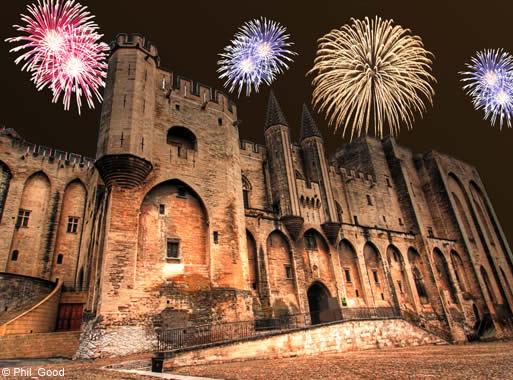
And as its name implies, here stands the formidable Popes' Palace, emblem of the city and awe-inspiring monument to the importance of Avignon in the Christian world of the Middle Ages.
Built in the 1300s, mainly by two popes - the austere Benedict XII and his successor, the much less ascetic Clement VI, - the palace would become the biggest gothic edifice in all of Europe. A tour of the palace, which includes the popes' private apartments with their fabulous frescoes, is one one of the musts of Avignon.
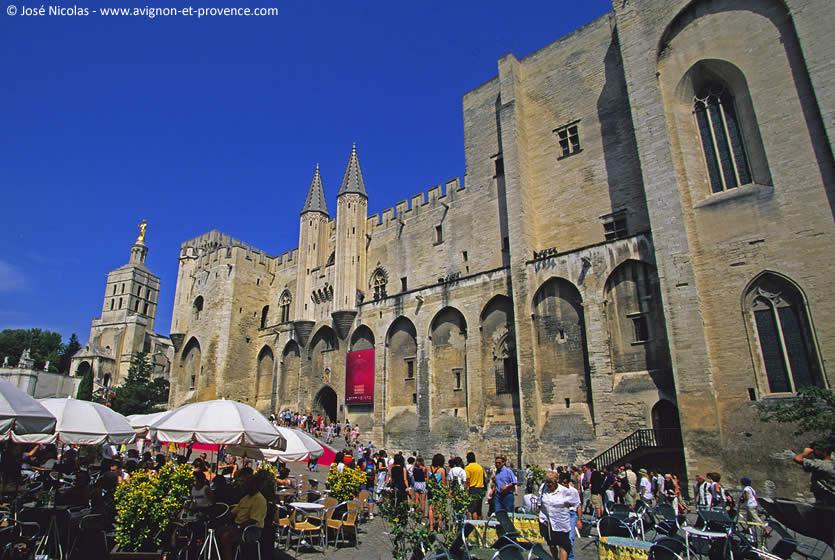
Palace of the Popes Square, Avignon Festival
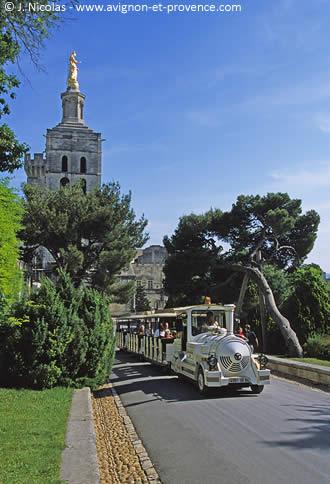
Next to the palace, the Notre-Dame des Doms Cathedral, built in 1150 in a Provençal Romanesque style, was put on the first very list of historic monuments in 1840. From the top of its bell tower, the statue of the Virgin Mary, entirely gilded in gold, 6 metres high and weighing 4500 kilos, blesses and protects the city.
Across from the palace, dragons and eagles stand guard over the imposing edifice of the Hôtel des Monnaies, once the city's mint. And not far away, the Petit Palais, a former cardinal's residence turned into a museum, houses an impressive collection of Italian primitive art, old sculptures by Avignon artists and paintings from the Avignon School.
If all this splendour and exuberance already has your head spinning, go up to the Rocher des Doms, the cradle of the city, for a refreshing break amongst the peacocks and swans by the pond. From this spot, you have panoramic views over the entire city, its tiled roofs and bell towers and over to Villeneuve-les-Avignon and all the surrounding areas.
At the bottom of the Place de l'Horloge, the main avenue, Rue de la République, divides the city into two. On one side, the Rue Saint Agricol leads to the chic and bourgeois quarter with the Rue Joseph Vernet, the 5th Avenue of Avignon where designer clothing and luxury goods shop abound, and the Place Crillon, with the prestigious Hotel d'Europe in a former private town mansion built in the 16th century for the Marquis de Graveson.
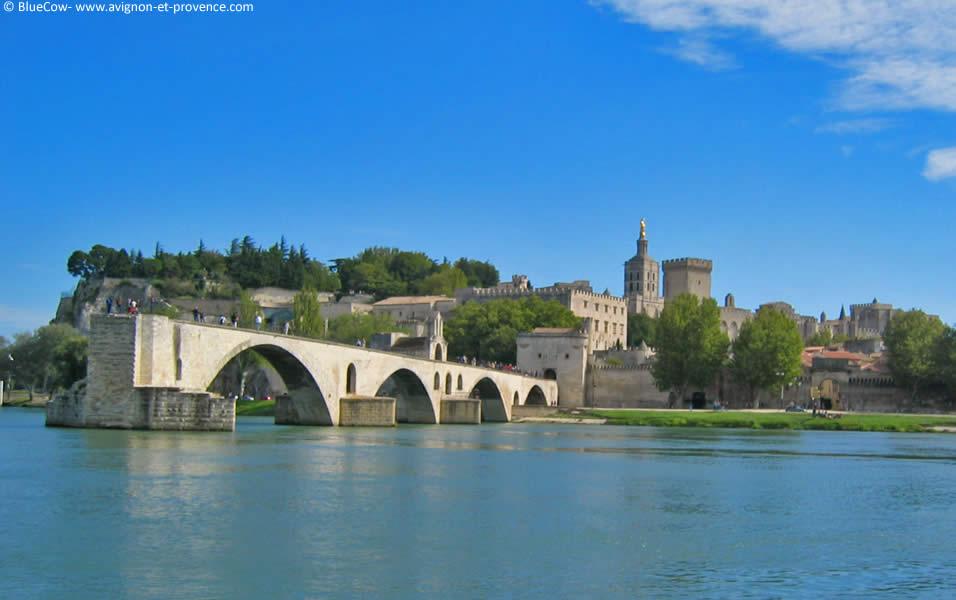
Panoramic view over Avignon from the Barthelasse Island
On the other side, the pedestrian and shopping zone leads to the Place Pie and the Halles, the covered market adorned with a hanging garden. A meeting place for the people of Avignon, the stalls offer all sorts of foods and treat. Don't go with an empty stomach!
Not far from there, the Place des Carmes also has two very popular markets: a flower and farmers' market on Saturday mornings and the flea market on Sundays. The square gets its name from the magnificent Carmelite cloisters and its 13th century convent church.
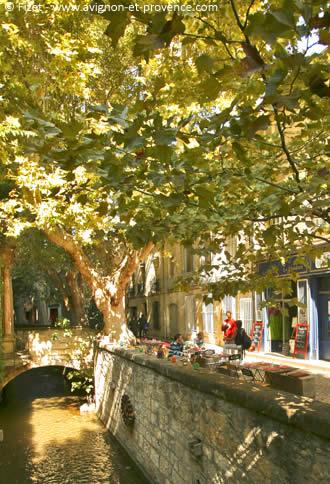
Or you can head to the bohemian quarter of Avignon and the Rue des Teinturiers bordered by the little Sorgue river. If it is not the centre of Avignon, the street is one of its “hearts”. Today haunted by artists and musicians as well as born and bred Avignonnais, this delightful cobblestone street dates from the Middle Ages and the period when the textile industry was in full swing.
If the water wheels, of which four still remain from their heyday, no longer turn, the street certainly swings with its wine bars, small cool restaurants, musical evenings, all in the shade of the sycamores and in an almost village-like ambiance.
If you want to open up your horizons, go do a tour of the ramparts. The Avignon city walls constitute the 2nd longest continuous wall in the world, after the Great Wall of China. You can access the walls' walkway from the Rocher des Doms or from the Saint Anne stairs behind the palace.
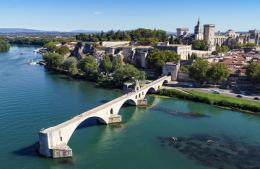
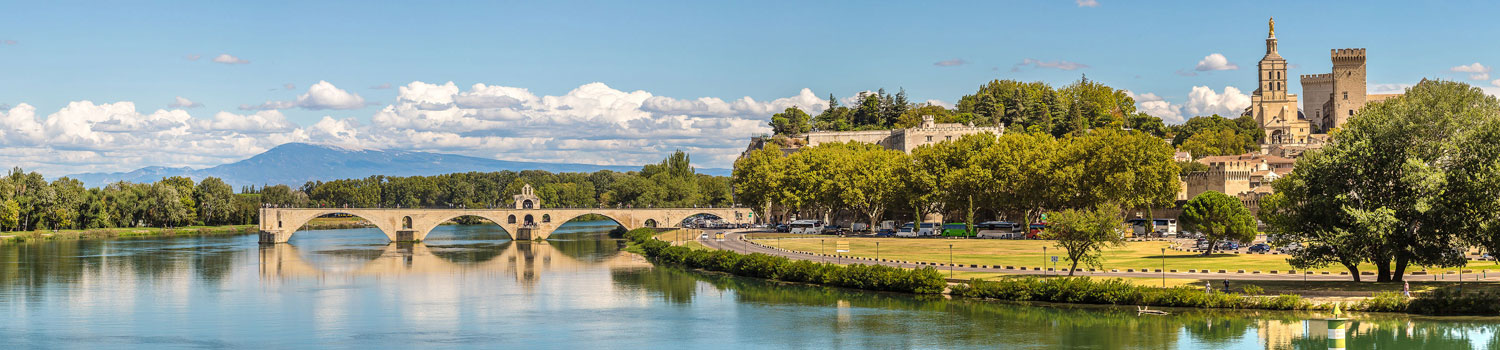
Then, go dance on the famous bridge of Avignon. The Saint Bénézet Bridge was built around 1180 – miraculously, according to legend, by a simple shepherd – to link the city to Villeneuve-les-Avignon.
Over the years, a war and successive flooding by the Rhône partially destroyed the bridge. Today, the 12th century Saint Nicholas Chapel remains, as well as four arches of which the span constitutes, according to a prestigious civil engineer, an amazing feat for the period.
At the foot of the bridge you will find the landing pier for the cable ferry that will take you free of charge to the Barthelasse Island for a stroll in the countryside just a stone's throw from the city.
Unless you prefer exploring one of the museums of which Avignon has many. Between the collections of contemporary art (the Lambert Collection) and of paintings (Musée Angladon and Petit Palais), the museum of Fine Arts (Musée Calvet), of archaeology (Musée Lapidaire) and of period furnishings and decorative arts (Musée Louis Vouland), you will be spoiled for choice.
And let's not even talk about the religious edifices!
Rabelais wanted to call the city the Ile Sonnante, or the Chiming Island, because of all the churches, chapels and convents. We can't list all of them here but mention should be given to the exquisite Saint Pierre Basilica, particularly captivating when illuminated at night, the majestic Saint Didier Collegiate Church and the Protestant church of the Temple Saint Martial.
Everywhere, just around a corner or on a small square, you will come across a penitents' chapel or small church, all of them housing treasures and artworks of inestimable historic value.
A city to be savoured in all seasons thanks to the many events that take place throughout the year, Avignon really takes on another dimension during its “5th season” in July, when the Avignon Theatre Festival takes place.
This festival of dance, music and theatre was founded in 1947 by the actor and director Jean Vilar (2016 will be the 60th festival). The shows are performed everywhere throughout Avignon, even in the streets. Today, it enjoys international renown but, with the less formal Festival Off, a close audience rapport has been maintained.
Advice to visitors: with all the pedestrian zones and one-way streets, driving can be difficult for those who don't yet know the city. On top of that, parking is sometimes a nightmare. If you are staying in one of the city's hotels, inquire at reception about the best way to park. If you are coming just for the day, consider leaving your car in one of the lots just outside the ramparts, such as the Parking des Italiens or on the Ile Piot; both of them have a free shuttle service into town every few minutes that even operates late into the evening in summer.
Art of living
Gastronomy, markets of Provence, regional products, Christmas traditions, celebrities of Provence....
Where to sleep?
160 EUR/night*
Bed and breakfast - Avignon and the surroundings