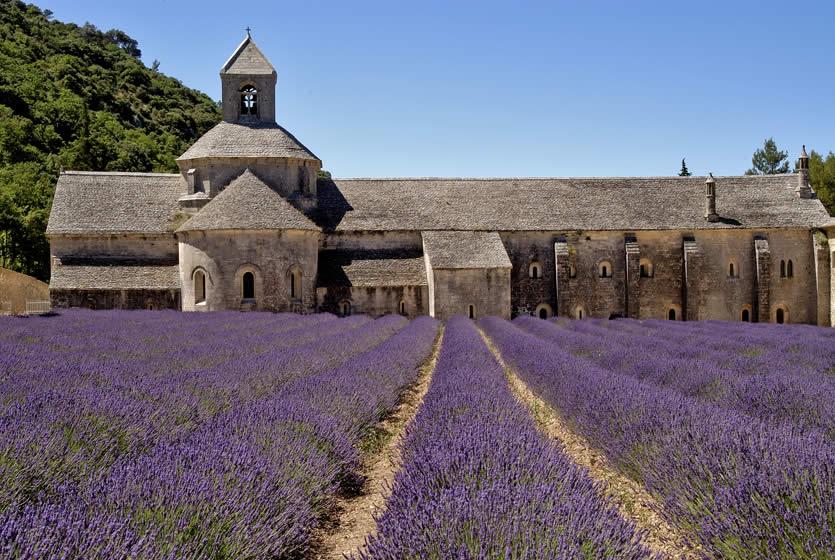
Nestled in the most secret of the Provençal hinterlands, the three Cistercian sisters reveal themselves as though regretfully to the visitor come to disturb the solitude of their retreat. They embody a different Provence than that of beaches, orchards, vineyards and majestic towns that attract huge crowds. This Provence is that of shaded valleys and wild stone, hidden streams and mystic springs.
Cistercian story
At the end of the 11th century, the Clunis monks ruled as lords over more than 1200 abbeys spread out throughout Europe, handing out their own justice and accumulating outrageous wealth.
The churches, with their inordinate, flaunting, grandiose proportions and ornaments, ignored the misery of the faithful, while the wealthy monks showed little taste for working the land, preferring to devote their time to the politics of the era. Then, just when at the time warrior orders like the Templars were developing, others judged it more urgent to once again adopt the poverty and humility of the first Christians.
Some monks started a reformed Benedictine abbey in Cîteaux, in Burgundy. Remote from all politics, without any real power, the new Cistercian order remained in the shadow of the powerful Cluny monks until a man with incredible charisma, St Bernard of Clairvaux, brought the momentum to this great cultural and architectural undertaking, which, at its height, would see several hundred abbeys spread across all of Europe. In Provence, the Cistercians founded three abbeys, which later were to be called "the three Provençal sisters": Thoronet, a few kilometers from le Luc, Senanque next to Gordes, and Silvacane at la Roque d'Anthéron.
Vision of Society
Bearing a true social plan, St Bernard of Clairvaux tried through poverty to draw the Church closer to the faithful and to reduce the imbalance of a society which had established a veritable rupture between the aristocracy, the clergy and the ordinary people considered just a labour reserve. Where the laypeople, religious auxiliaries coming from the plebeian, had still been subject to a system of quasi-serfdom, Bernard of Clairvaux made them free men, who shared fully in the life of the abbey, participating in the services and attending chapters.
The Cistercians´ days were long, divided between prayers and working the fields side by side with the laypeople, broken only by seven hours of rest a day.
The meals were taken in the common refectory : meager dishes accompanied by a little bead and wine. As you enter the dormitory, you can easily imagine the cistercians monks sleeping fully-dressed right on the floor, lit by a window to the east and one to the west to benefit from all the light of the day.
At the church´s threshold, one individual cell, cramped and bare, marks the sole privilege of the abbot. At the time of their death, the cistercians monks, carried by their brothers, crossed the door of death, to lie on an altar of rough stone, dressed in their only habit, before being buried directly in the ground.
With the decline of the cistercian order, the dormitories designed to accommodate the ever-increasing number of monks began to empty progressively until the French Revolution.
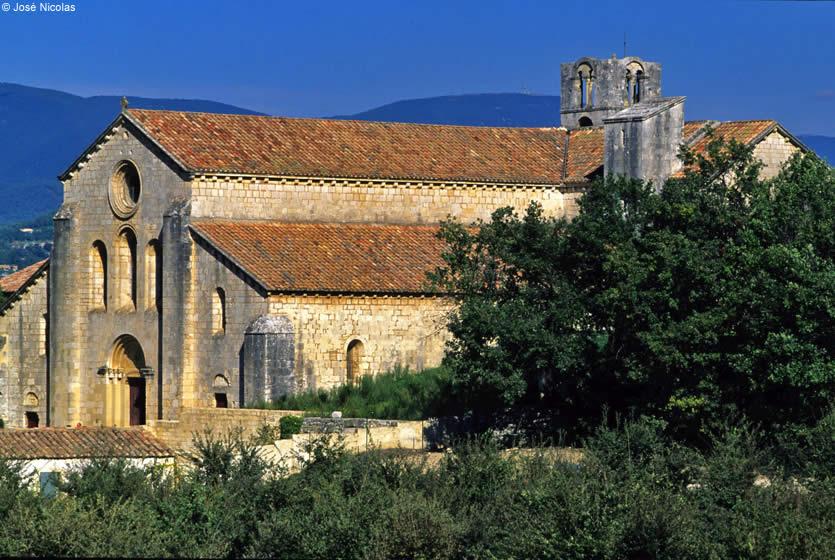
Silvacance Abbey in la Roque d'Anthéron
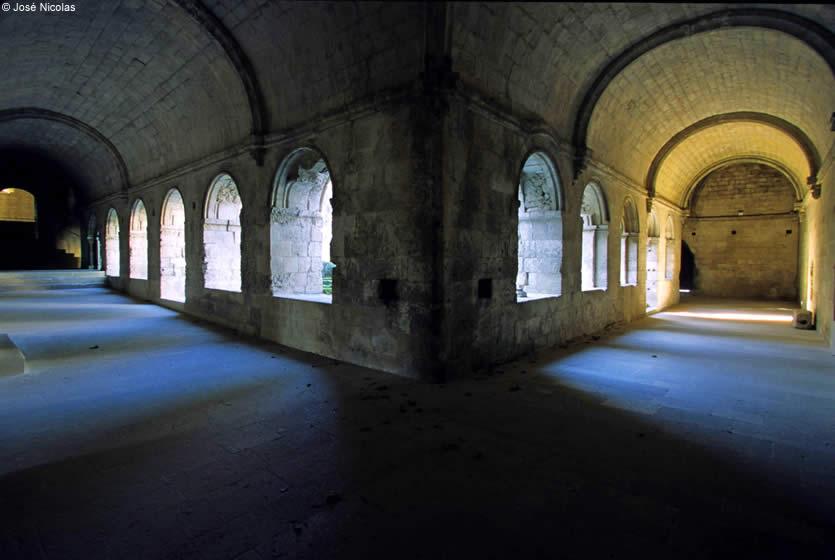
Cloister of the Silvacance Abbey
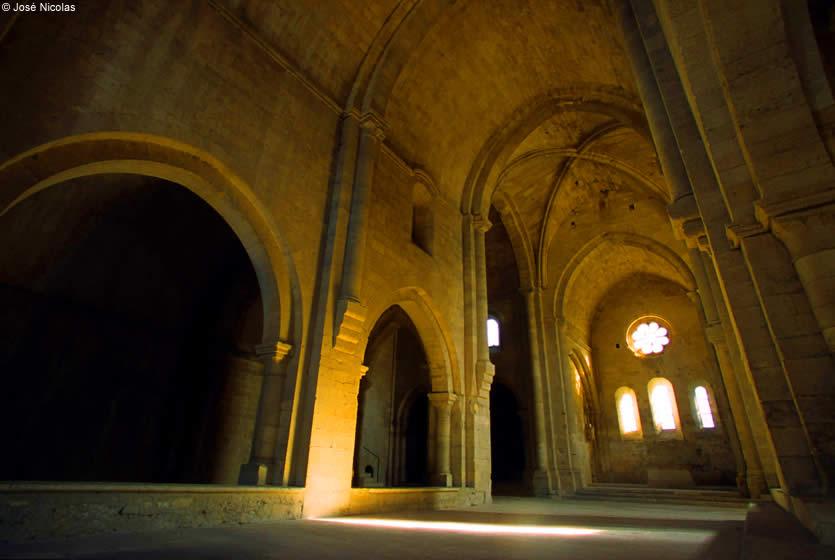
The abbey church of Silvacane
Light and song as their only riches...
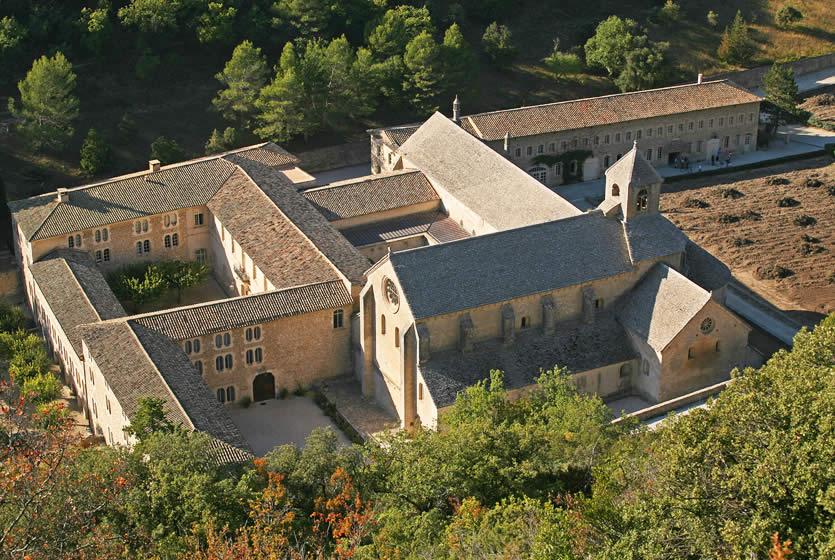
For setting up the abbeys, St Bernard of Clairvaux advocated sites favorable to both meditation and human occupation. If the presence of water is fundamental, we can see that the necessity of the spot´s remoteness and fullness often prevailed over architectural obligations. The church of Senanque, constricted by the canyon of Senancole, is not oriented towards the East, as tradition and St-Bernard´s plan would have it, but to the North, while the slope of the valley of Le Thoronet or the reed forest of Silvacane drove the architect to lay the site out in tiers so as to manage the slope while keeping the coherence of the whole and the vertical symbolism of the buildings. Harmony and simplicity led the monks to choose for their buildings the rocks on which they sat.
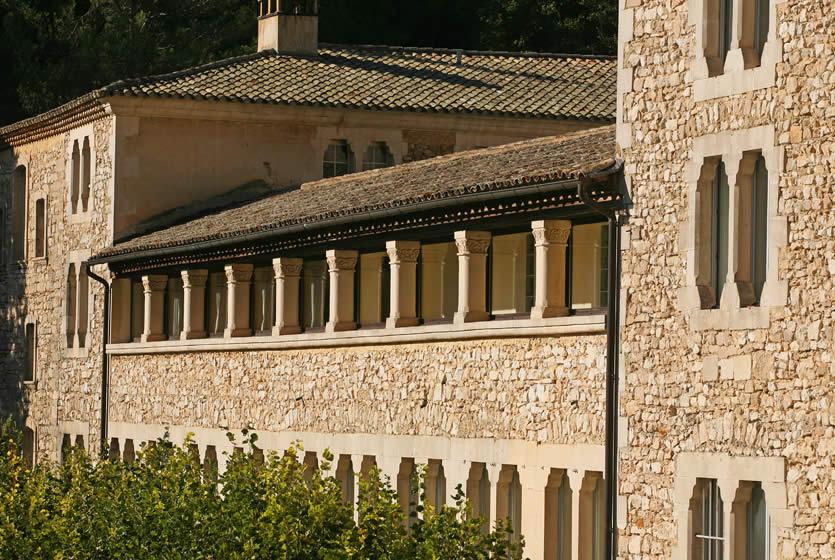
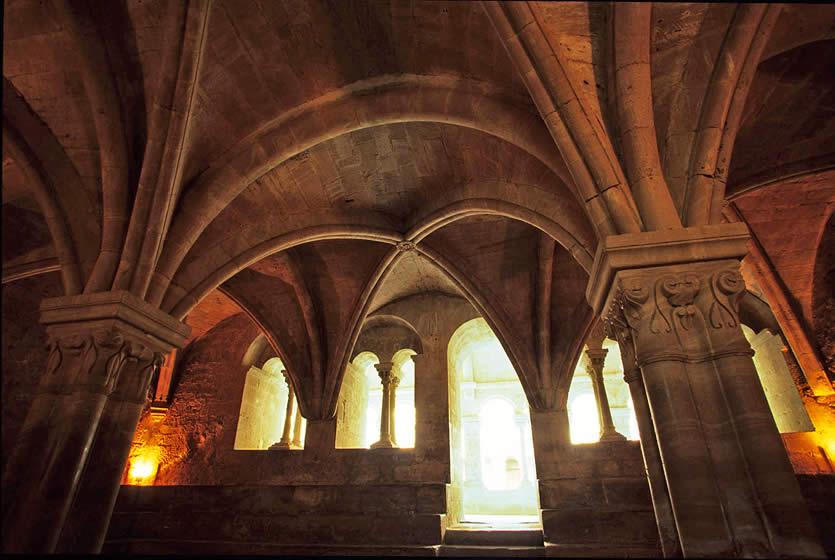
Thus arose living, colored walls, whose different strata reveal the geology of the spot : tufa gray, yellow marl, pink bauxite... Stripped of all pomp, Cistercian harmony rests on no more than the purity of the lines, the light and song. Instead of the symbolism of the icon, it prefers that of number and form : gothic arches to support the load and giving the whole a thrust towards the sky, the chapter house lower down to show the temporality of the word pronounced there, accessed by three steps, lit by three openings signifying that each of those words are pronounced before the Holy Trinity. Only the chapter rooms are adorned with representational symbols. Rare and limited to these rooms only, they symbolize the abbot´s authority there or the abbey´s affiliation ( such as leaves inspired by the symbol of Cîteaux). In Sénanque, an audacious architect placed across from the abbot´s seat, at the entrance to the chapter house, the effigy of a cannibalistic monster symbolizing at the same time the devil and the rebirth of the body devoured by the earth at the moment of death.
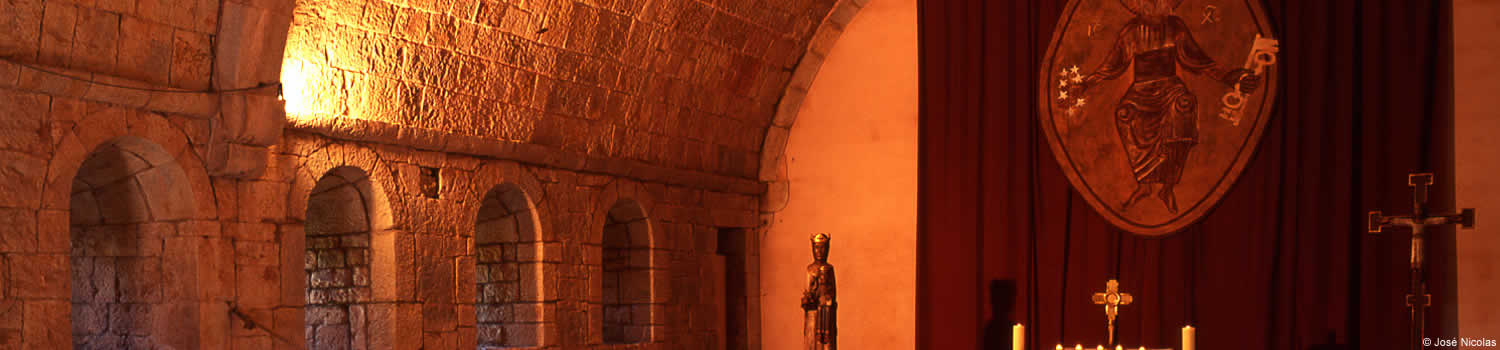
In the heart of the abbey, no stained glass window disturbs the light. The wall over the sanctuary is set with one simple opening, of which the radiance establishes an almost supernatural bond between monk and God. The windows are made of interlacing pieces of white or gray glass set with lead. The Cistercians also gave a particular importance to the acoustics of their churches, which distinguishes itself by an echo of an average of ten seconds.
In Thoronet, where the echo lasts fourteen seconds, the guides don´t hesitate to sing out some Cistercian-like chants to prove these extraordinary acoustics, that you can hear, as well, during the concerts organized every year be the abbey. The commentary knows not to overwhelm the visitor with architectural knowledge, rather letting him or her soak up the magic of the place.
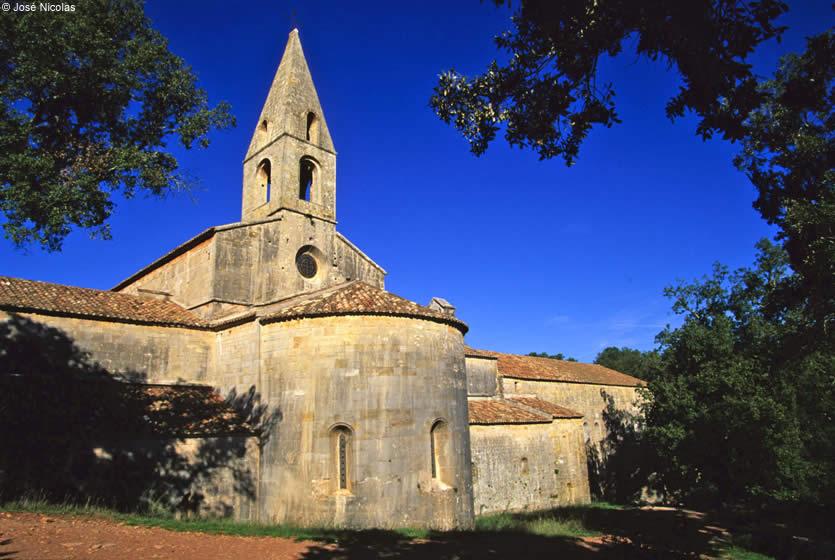
The Thoronet Abbey in the Var
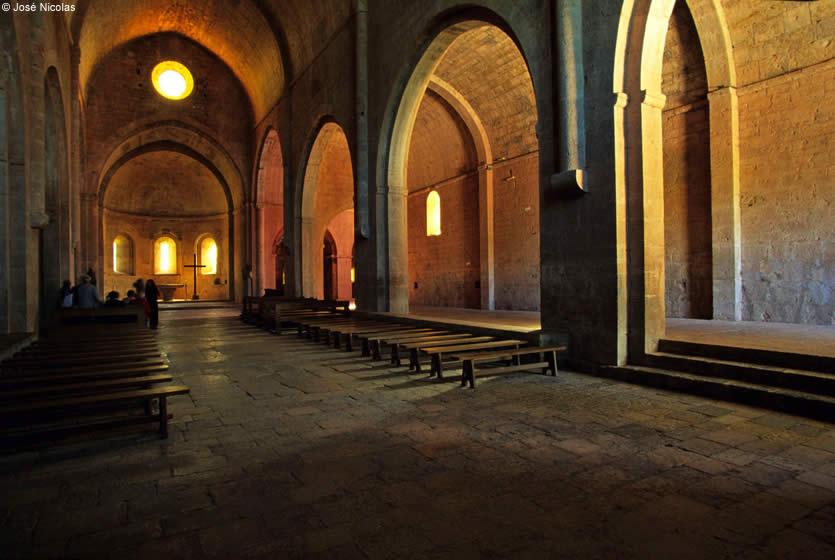
The abbey church
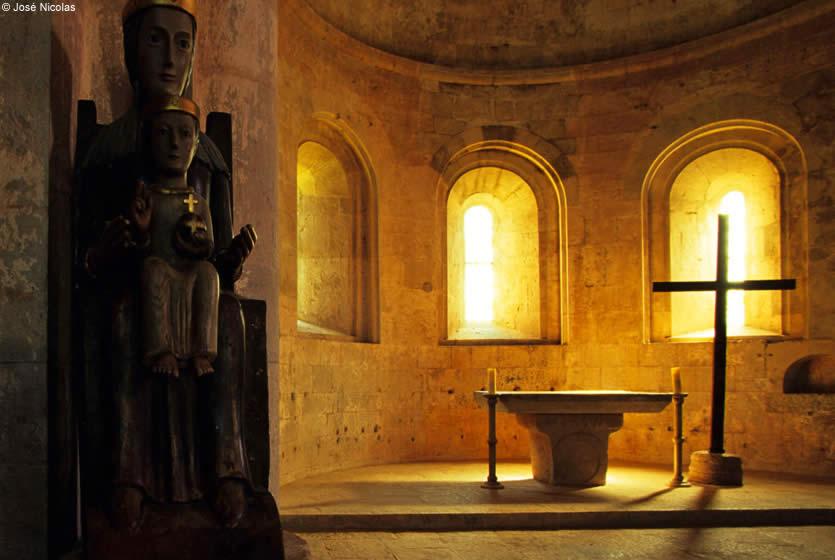
The altar
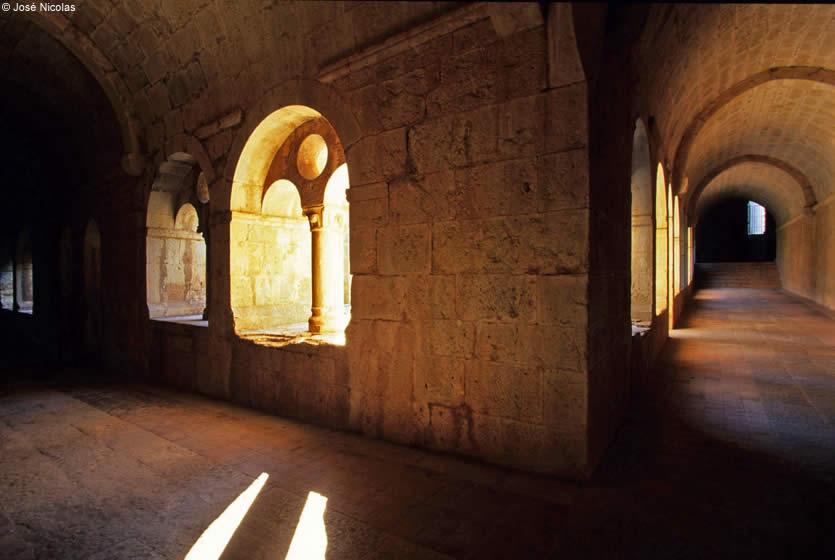
The cloister
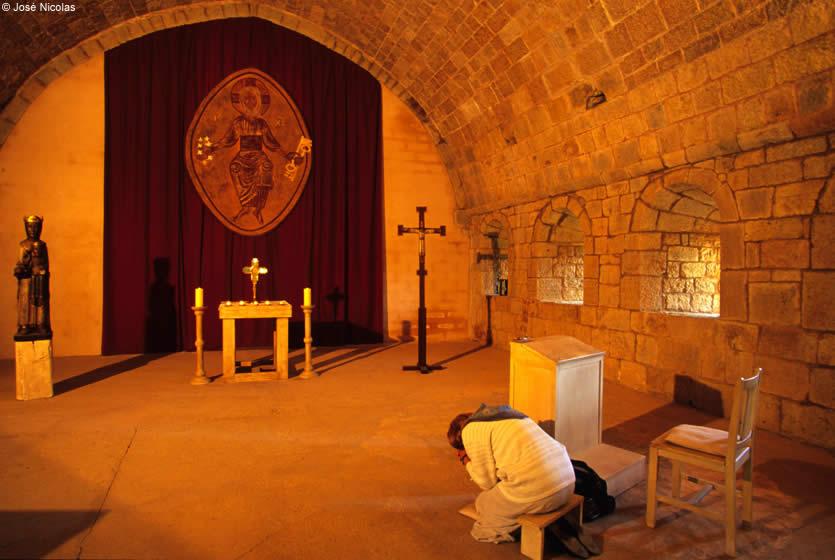
A moment of prayer and meditation
Decline
Invariably, a visit to a Cistercian abbey begins by a slow descent along a dusty road through the Provençal desert, until coming to the unpretentious gate of a church whose greenery is the only setting and the only walls. Contrary to the edifices of other brotherhoods, the Cistercian abbeys had no defense, as the re-establishment of a very real poverty would have aux discouraged any pillagers. There is nothing to suggest that at their height, towards the beginning of the 13th century, the three sisters accumulated a wealth that brought them closer to the Cluny monks than to the spirit of St Bernard of Clairvaux.
Their farms grew, with barns sometimes quite far from the abbey itself, and the seigniorial rights, their urbane houses, their saltworks, their pasture land by the sea and in Haute-Provence, aroused a lust for wealth of which Bernard could have had no idea. The Cistercians, becoming bishops and popes, joined the dissoluteness of the world and discipline slackened. Belltowers, considered signs of vanity, were built and equipped with powerful bells, while in Le Thoronet, gourmet monks enjoyed feasts of game and fine fruit. Bands of Vaudois pillaged, sacked and burnt a part of the Sénanque abbey, while Benedictines of the arrogant abbey of Montmajour besieged Silvacane, killing some monks and driving out the others.
Ruined, the abbey became a bandits den. Only the abbey of Le Thoronet, which remains the most interesting of the three, came out more or less undamaged by these troubles times. The stones retain the memory of Bernard´s utopia and its inevitable failure.
The visitor here becomes aware of the constant struggle between ideals and the human state, and can finally assess that the extent of a dream is certainly weak in the face of history. What remains are three magnificent abbeys and a sort of strange sentiment of plentitude, soothed by the last echo of the Cistercian chants.
Text: Philippe Reyt
Other accommodations
Vacation rentalWhere to sleep?