The Tour de Brau town house
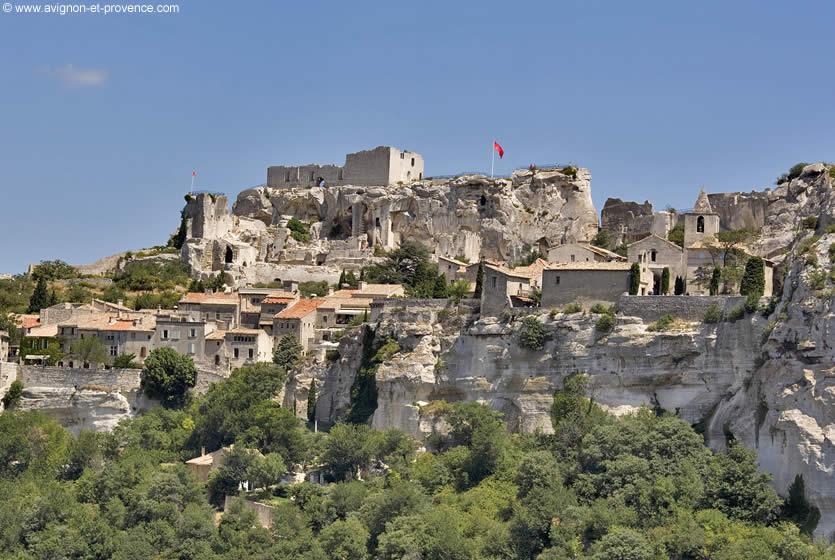
The Tour de Brau town house is a reminder that sumptuous residences were once built in Les Baux de Provence by powerful Provençal families. It's a fine, late 15th century building with its lofty vaulted.
The Chapel of Saint Blaise and the cemetery

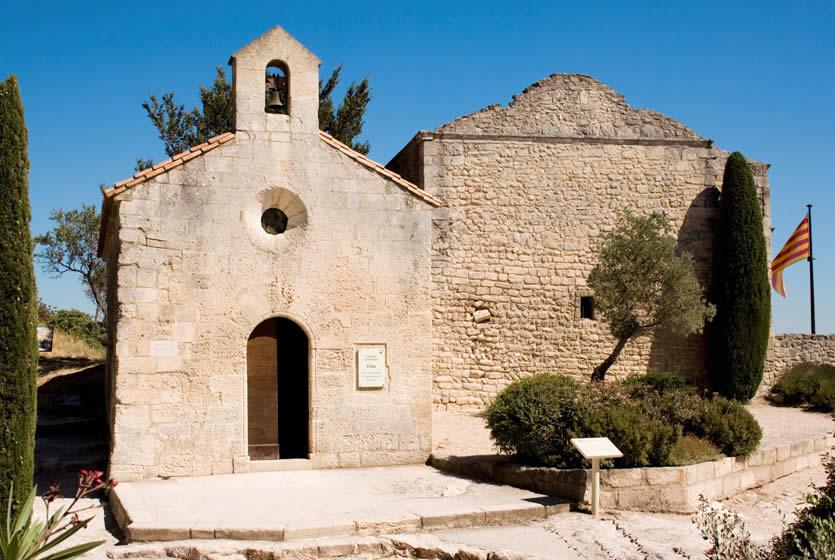
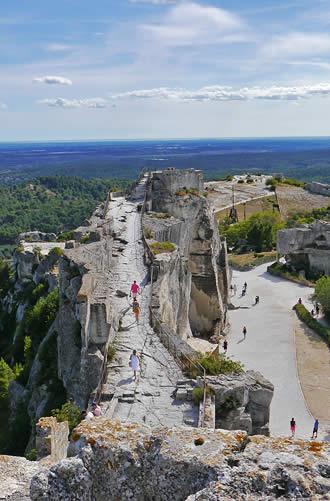
But enough of the fury of warring men ; let us turn to more spiritual concerns. The Chapel of Saint Blaise, a stone’s throw from the museum, was built in the 12th century. As you pass through, take a look at the western façade, and the door surmounted by an oculus. The guild of wool carders and cloth weavers that frequented the chapel evidently led busy lives. These days, the chapel is the setting for an audiovisual film entitled : "Van Gogh, Gauguin and Cézanne in the land of olive trees". Nearby, perched on the rock, the cemetery overlooks the valleys of Enfer (meaning "Hell" - what more reassuring position to be laid to rest ?) and Fontaine. A serene spot bathed in poetic charm. Here lies the Provencal painter Yves Bayer and poet André Suarès (1868-1948), friend of André Gide, Paul Claudel and Charles Péguy.
Quiqueran hospital, the old windmill and the statue of Charloun Rieu
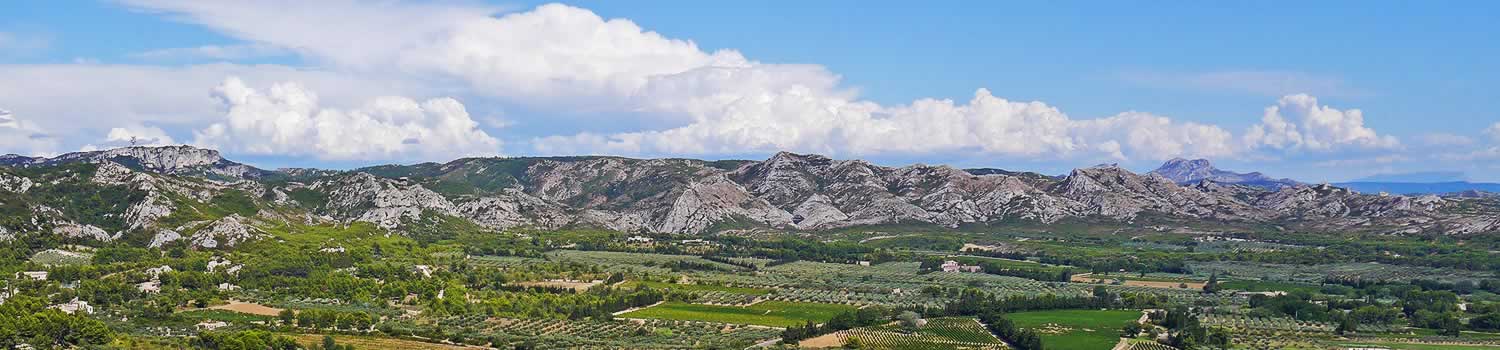
Leaving the cemetery, we come to Saint André’s hospital. The hospital was built between 1542 and 1583 under the patronage of Jeanne de Quinquéran, wife of Honoré des Martins, governor of Les Baux de Provence. Later renamed "Hôtel Dieu et charité des Baux", it closed its doors in 1787. Its south-facing ruins present only the slightest traces of the first floor gallery with its ornate gilded columns. The paved surface covering some 30 ares collected rainwater and drained it into a tank hollowed out in 1868. This tank held no less than 882 m3. The windmill, famously preserved for eternity in the opening lines of Alphonse Daudet’s Lettres de mon Moulin, is due south of the plateau. Lastly, at the very top, the statue of Charloun Rieu stands in memory of this Provencal poet (1846-1924), who sang of the lands of Les Baux de Provence. His stony eye gazes for ever over the stunning landscape that stretches before him, from Les Alpilles to the Etang de Berre (Berre lagoon).
The Saracen Tower
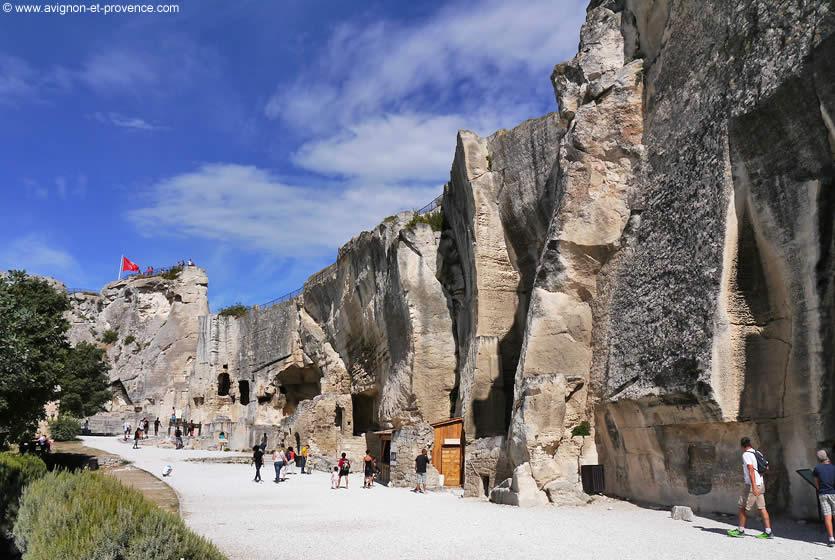
There are stones and more stones everywhere you look... But look closely and you will also see rock dwellings dating from the Renaissance. Up above is the Saracen Tower, a
Press Release – Château des Baux de Provence once-perfect cube standing tall on the craggy rock. It was named for a reason, as it would provide a warning of the return of any Infidels. On the other side, the Bannes Tower overlooks the dovecote. Two perpetual witnesses of a highly effective defence.
The castle chapel
A little further on, we come to the castle chapel. The chapel was originally dedicated to Our Lady, who was succeeded by Saint Catherine in the 16th century. Reworked, the chapel today has magnificent vaulted bays. It retains Roman structures which constitute the oldest vestiges visible in the castle today.
The Chateau of Les Baux de Provence
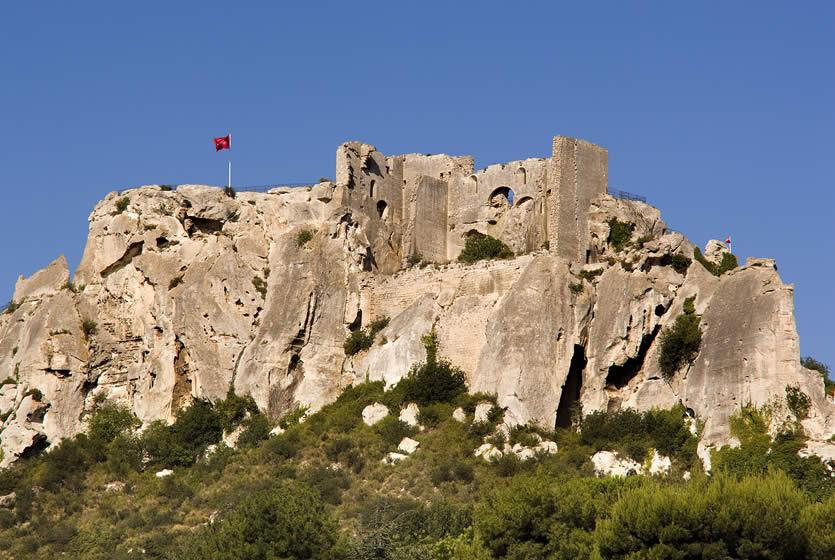
There it is, at the tip of the rocky outcrop, facing the Paravelle Tower : the donjon. The donjon at Les Baux de Provence is the most representative vestige of this type of military architecture. Anchored in the rock since the 12th century, the last bastion of an absolute defence. Hollowed out in parts, it has many underground rooms. Short on comfort perhaps, but nowhere safer ! But a lack of comfort does not automatically imply a lack of sophistication, as borne out by the decorative vestiges adorning the donjon. See the two ornate sculpted amortisements, one depicting Saint George slaying the dragon, the other a griffon, or, at the base of the donjon, the Gallo-Roman stele. The history of the donjon mirrors that of Les Baux de Provence itself : destruction (under Louis XI), reconstruction (in the 14th century, by Anne de Montmorency), followed by final demolition (under Louis XIII). A turbulent existence, punctuated by violence.
Forgotten colour
What was life like in the Château des Baux de Provence ? And what did it contain ? The past cannot always defy the present. Sometimes, it gives away its secrets - in this case, in great detail. The Les Baux de Provence of the past is revealed in an inventory drawn up in 1426, after the death of Alix, the very last Lord of Les Baux. At that time, the castle was magnificently decorated. Tapestries adorned the walls - in the colours of the Les Baux de Provence coat of arms, naturally, but also those of Orange, Toulouse, Valentinois and Apchier. Colours that today’s visitor can hardly imagine. Each room bore a name : the Rose room, the Bishop of Tortose room, etc... The image of the barbaric warrior fades, replaced by that of the courtly knight. Adjoining the castle are, in a row, two long rooms and the dovecote with its small rectangular compartments.